
Exploring Decaf Coffee Trends Among Top World Coffee Roasters
Quick Analysis of data from 100 Roasters


Decaf coffee has been steadily gaining popularity as consumers are becoming more health conscious. Some are trying to improve the sleep quality, while others develop sensitivity to caffeine. The latter is what happened to me about 5 years ago leaving me no choice but give up my favourite drug! In this article, I delve into the trends and insights gathered from a dataset of some of the top world coffee roasters (according to a recent post by Roastful), focusing on their decaf offerings. We'll explore the percentage of roasters offering decaf options, popular origins, taste notes, processes, decaffeination methods, and which countries are more likely to offer decaf. Additionally, we'll discuss common varieties, top farms, and roast levels.
Percentage of Roasters Offering Decaf Options
From the dataset, we found that 58.82% of the top world coffee roasters offer decaf options. This indicates a significant presence of decaf in the specialty coffee market, catering to the growing demand for caffeine-free alternatives.
However, the majority of roasters only offer one decaf — only 6 roasters offer 2 or more options. In half of those cases, the second decaf option is a different roast (espresso and filter).
Popular Origins and Taste Notes
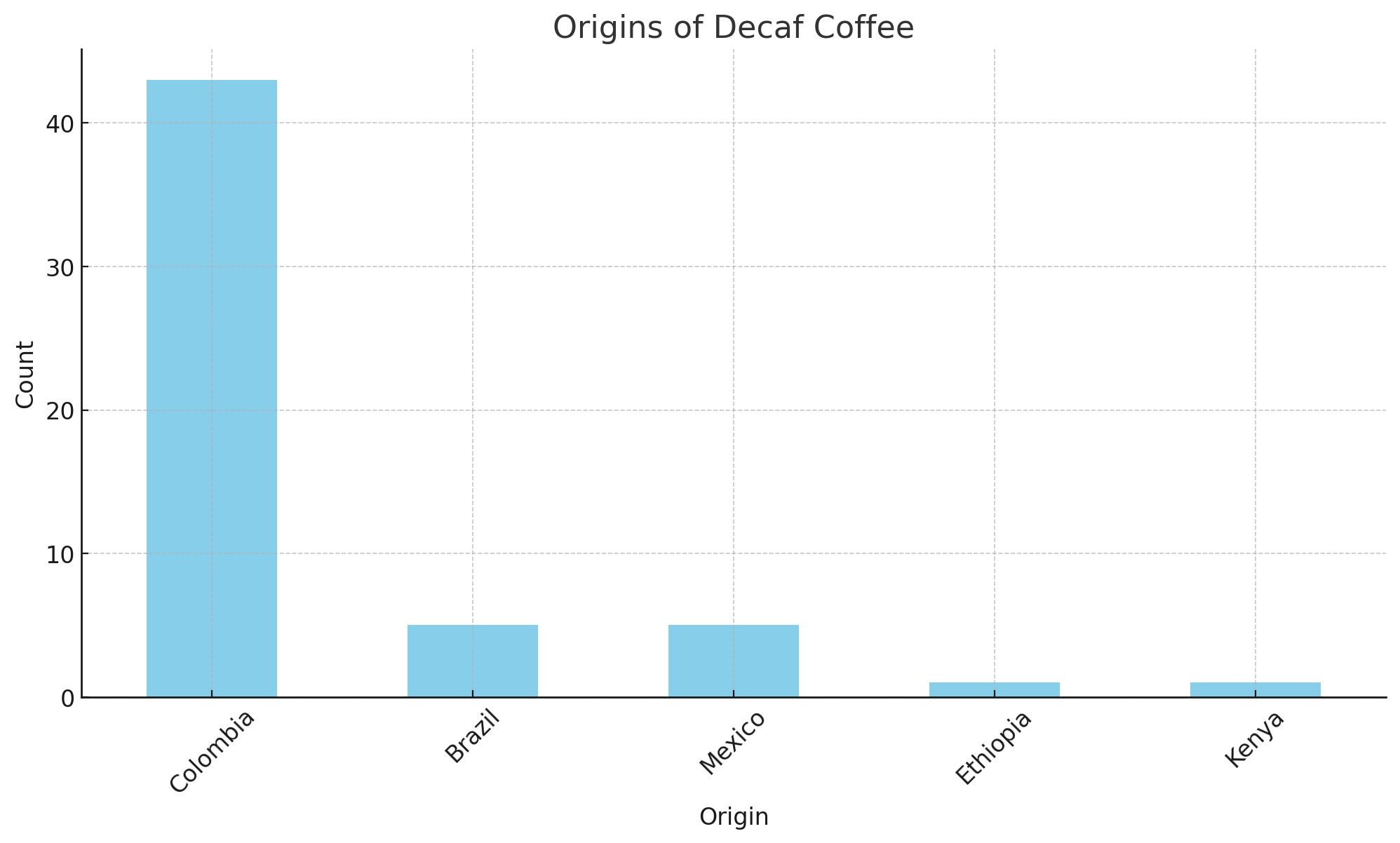
Origins: The majority of decaf coffee originates from Colombia, which leads with a substantial margin, followed by Brazil and Mexico. This is not surprising given Colombia's reputation for producing high-quality coffee beans.
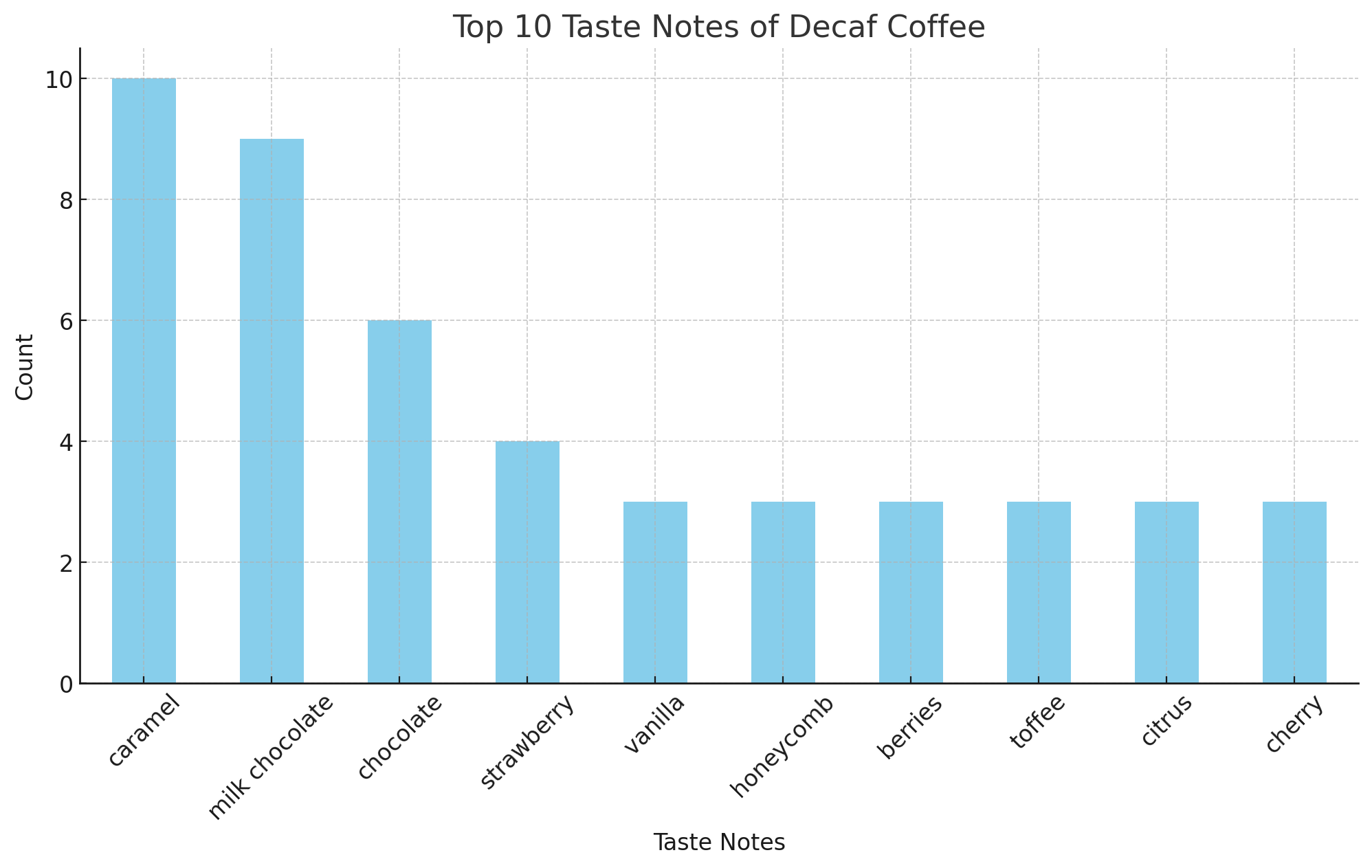
Taste Notes: The most popular taste notes among decaf offerings are caramel, milk chocolate, chocolate, strawberry, and vanilla. These flavours are likely chosen to appeal to a broad range of coffee drinkers looking for more traditional coffee flavours. Bad news if you’re into funky flavours as the options are very limited (for now).
Processes and Decaf Methods
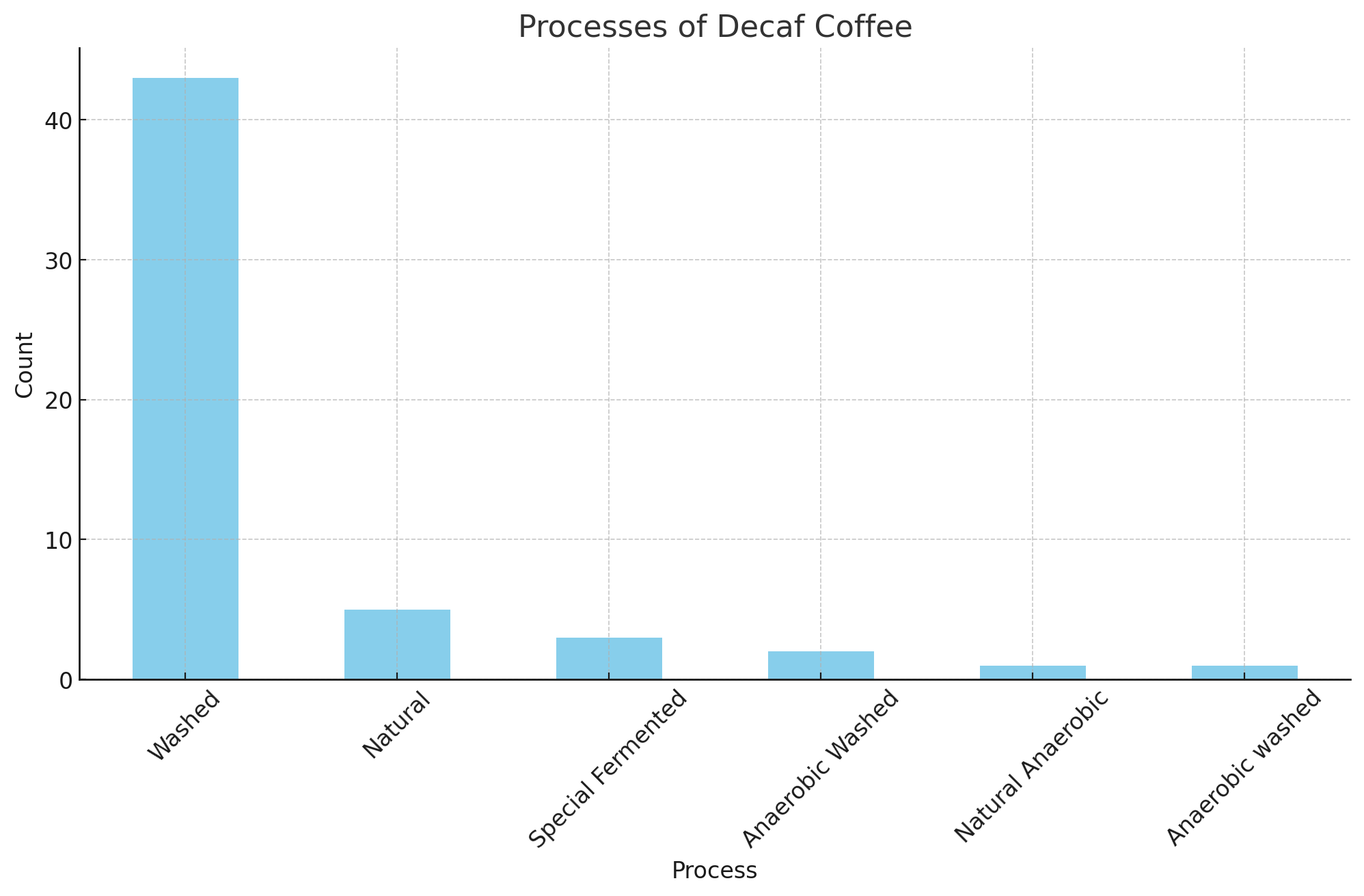
Processes: The most common process for decaf coffee is the washed process, which is preferred for its ability to produce clean and consistent flavour profiles. Other methods like natural and special fermented processes are also used but to a lesser extent.
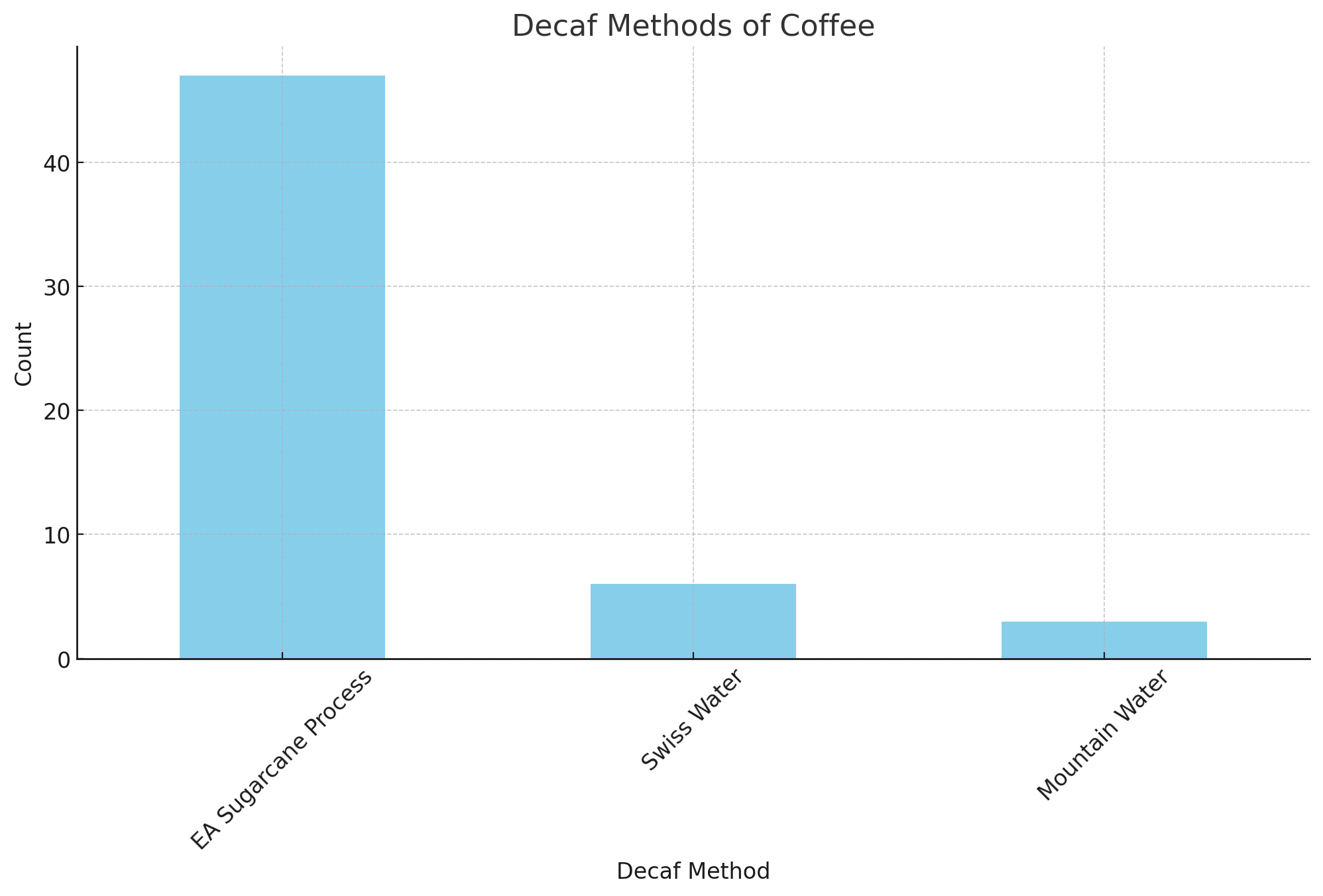
Decaf Methods: The EA Sugarcane Process is the most popular decaffeination method among top specialty roasters, followed by the Swiss Water Process and Mountain Water Process. The EA Sugarcane Process is valued for its ability to preserve the coffee's natural flavours while removing caffeine. It’s also worth noting that it’s the decaffeination method preferred by Colombian farmers as it can be done locally.
Common Varieties
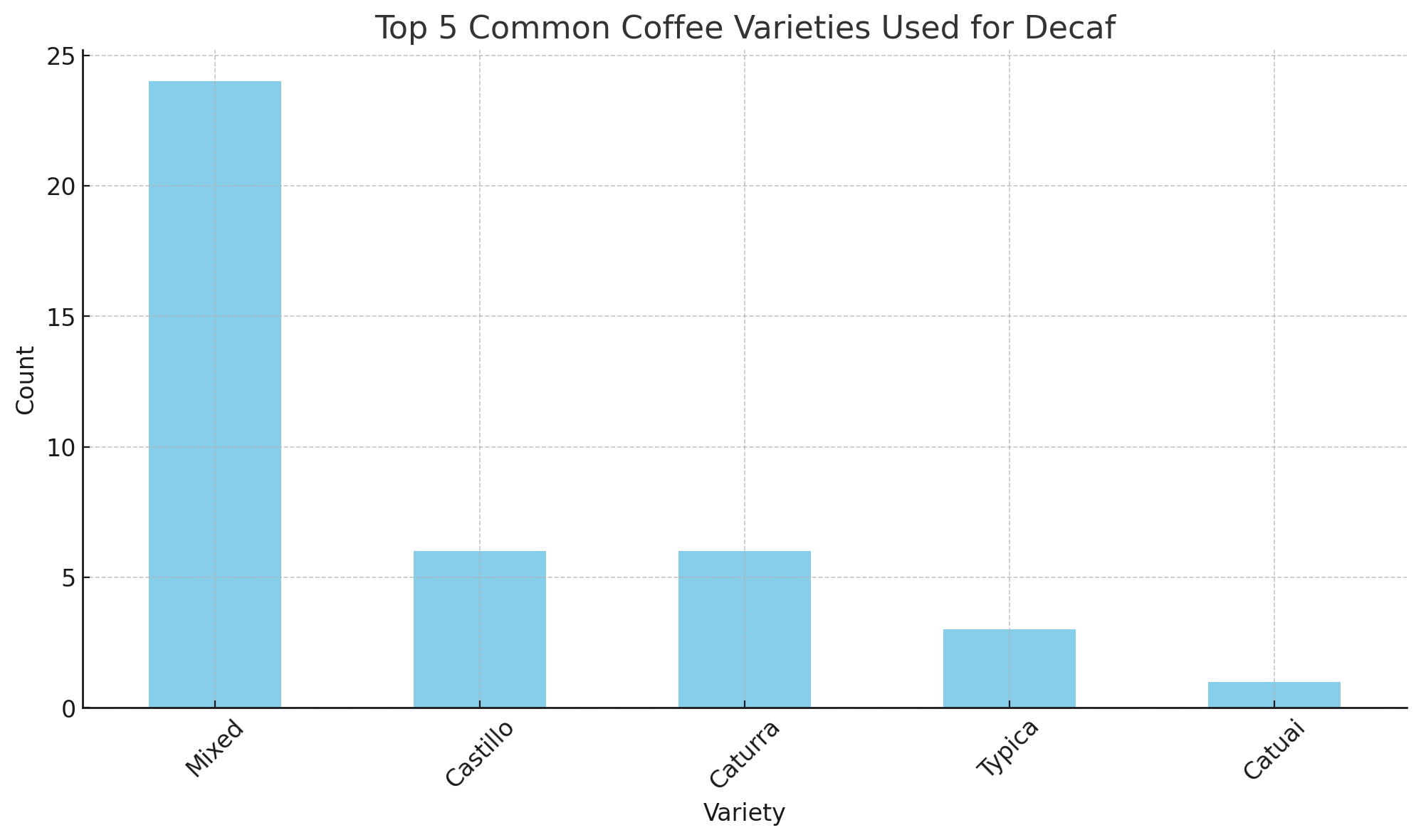
The most common coffee varieties used for decaf are mixed (usually, including Caturra and Castillo) followed by Castillo, Caturra, and Typica.
Top Farms and Detailed Farm Information
Top Farms: Among the roasters who provide a decaf option, 18 entries have non-specific farm information, indicating a need for more transparency in the decaf coffee supply chain. The top farms providing decaf coffee for some of the top world coffee roasters are:
Farmers From Pitalito, Huila: 5
Los Nogales - Oscar Hernandez: 4
El Vergel Estate (Elias & Shady Bayter / El Vergel Estate): 3
50 Smallholder Producers: 2
La Serrania: 2
Not surprised to see Los Nogales1 on the list as their typical decaf was used by the winner in this year’s US Brewers Cup. However, it’s a bit disappointing to see that most of the top roasters are not putting as much effort into their decaf offerings and are not after more experimental coffees (e.g., El Placer decaf by Sebastian Ramirez or Yenni Esperanza’s El Paraiso decaf).
Roast Levels
Roast Levels: Among the roasters offering decaf, 75% provide some information about the roast level. As expected since most roasters offer one decaf options, decaf coffees are more likely to be omniroasts or medium-dark.
Country-Specific Trends in Decaf Offerings
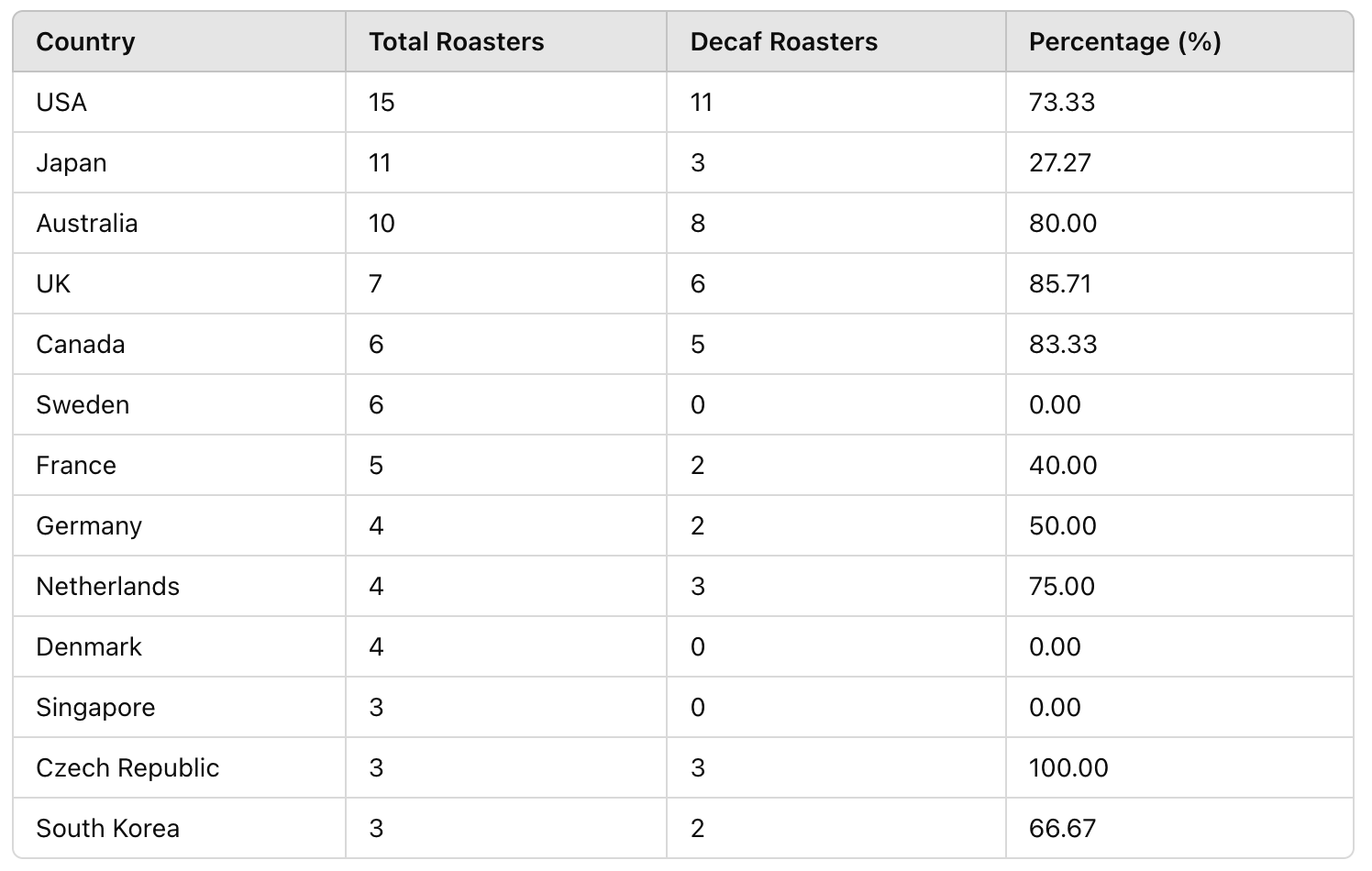
The table below shows the number of total roasters and the number offering decaf options by country (from the top 100 list used in this analysis). Only countries with more than 1 roaster were included:
Key Observations:
UK, Canada, and Australia: These countries have a high percentage of roasters offering decaf, indicating a strong market preference for decaf coffee.
USA: With the highest number of roasters, a substantial percentage (73.33%) offer decaf options, reflecting significant demand.
Japan: Despite having a large number of roasters, only 27.27% offer decaf, suggesting different consumer preferences.
Czech Republic, Switzerland, Spain: These countries have all their listed roasters offering decaf, showing a dedicated presence of decaf coffee in their markets.
The Nordics: Even though some of the world’s top roasters are in Sweden and Denmark not a single one offers a decaf option. I’d like to better research what’s the reason behind this.
Conclusion
That’s the end of my brief analysis. Yes, the decaf market is growing but we still have a long way to go. Perhaps we need to compile a list of roasters who care about decaf — if you have any suggestions, please share it in the comments below.
Interesting. Thank you for the analysis. As a decaf coffee enthusiast, I’m very glad I found you and that someone is actually interested in this and writes about it. Please share more of your observations and analysis about decaf. I’ve followed you.